 English
  Arabic
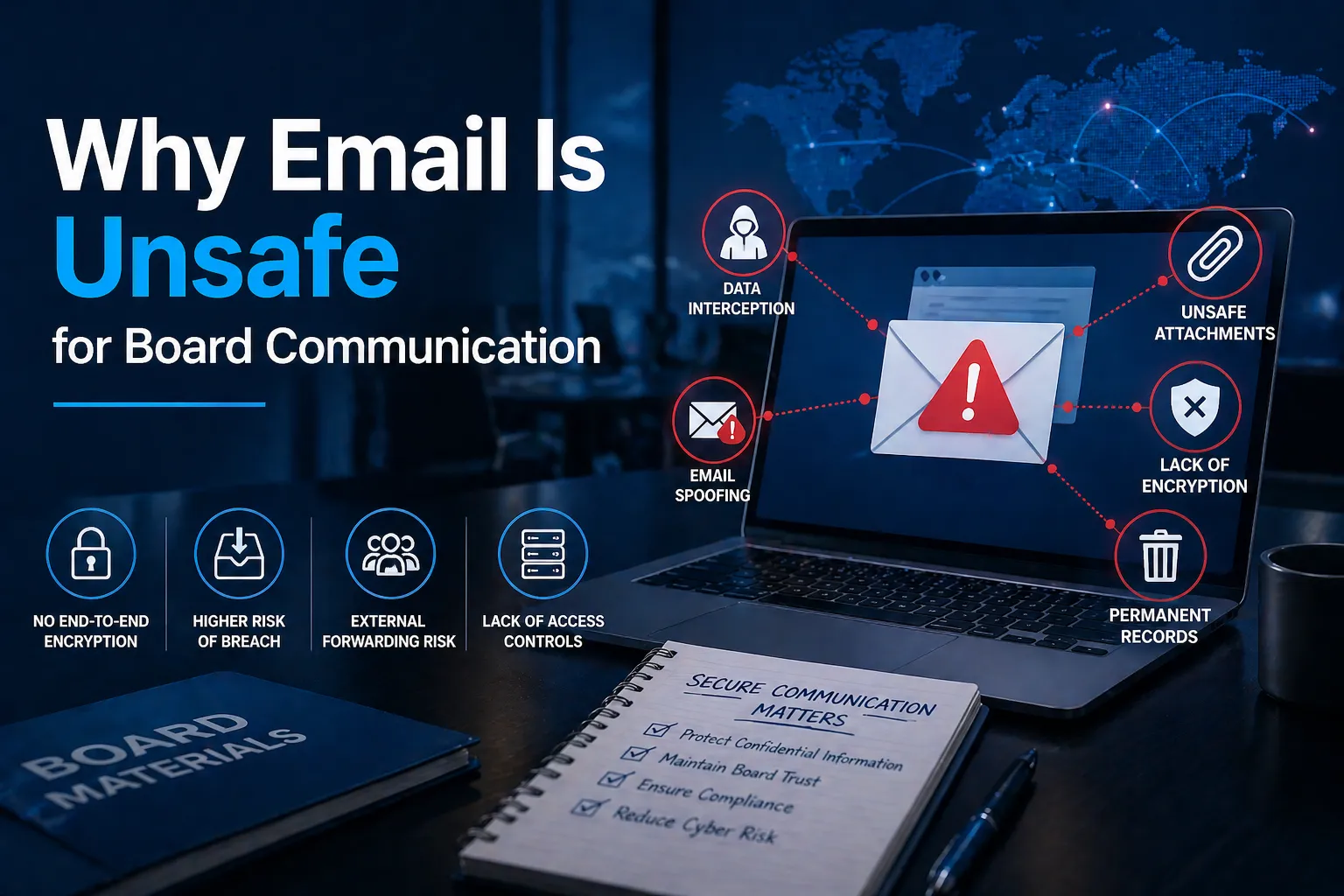
Why Email Feels Safe but Creates Real Exposure Email has become deeply embedded in organizational workflows. It is fast, familiar, and easy to use. However, its widespread use creates a false sense of security when handling sensitive board-level information. Board members often assume that corporate email systems provide sufficient protection. In reality, email lacks the control mechanisms needed for secure governance communication. Technology author Nicholas Carr once said: “The more we use technology, the more we need to question how we use it.” Email is a clear example of a tool that is widely used without fully understanding its limitations....

Why Email Feels Safe but Creates Real Exposure
Email has become deeply embedded in organizational workflows. It is fast, familiar, and easy to use. However, its widespread use creates a false sense of security when handling sensitive board-level information.
Board members often assume that corporate email systems provide sufficient protection. In reality, email lacks the control mechanisms needed for secure governance communication.
Technology author Nicholas Carr once said:
“The more we use technology, the more we need to question how we use it.”
Email is a clear example of a tool that is widely used without fully understanding its limitations.
How Email Opens the Door to Security Risks
One of the biggest risks with email is its lack of control after sending. Messages can be forwarded, copied, or accessed without restriction. This makes it impossible to ensure confidentiality.
Another issue is phishing attacks. Board members are prime targets because of their access to sensitive information. A single compromised account can expose an entire communication chain.
Email also creates confusion with document versions. Multiple versions of the same file may circulate, leading to errors and misalignment.
The Hidden Costs of Email-Based Communication
The risks of email are not limited to security breaches. They also affect efficiency and decision-making. When information is scattered across inboxes, it becomes difficult to maintain a single source of truth.
This leads to delays, as board members spend time verifying information instead of making decisions.
Security researcher Mikko Hyppönen explained:
“If it’s smart, it’s vulnerable.”
Email systems, while advanced, remain vulnerable due to their design.
Why Organizations Continue to Rely on Email
Despite its risks, email remains widely used because of its convenience. Organizations are often reluctant to change established workflows.
Another reason is lack of awareness. Many board members do not fully understand the risks associated with email communication.
What Safer Communication Looks Like
Secure communication platforms provide features that email cannot. These include controlled access, encryption, and centralized document management.
Such systems ensure that only authorized individuals can access sensitive information. They also provide visibility into how data is used.
How to Transition Away from Email
Organizations must take a structured approach to reduce reliance on email. This includes introducing secure platforms and training board members on their use.
Clear guidelines should define when and how communication should occur.
Frequently Asked Questions
Why is email unsafe for boards
Because it lacks control and is vulnerable to attacks.
What is the best alternative
Secure board communication platforms.
Can email be made secure
It can be improved but remains unsuitable for sensitive use.
Final Perspective
Email may be convenient, but it is not designed for secure governance communication.
Share this article on