Hello , Stay ahead of the news and trends impacting G&C for leaders.

Discover resources and insights spanning governance best practices, ESG, compliance, and board management.

Featured Posts

Board Deck Management
How Poor Organization Hurts Board Performance and Governance Outcomes
Why Board Organization Is the Silent Driver of Performance Board performance is often judged by outcomes such as strategic decisions, risk management, and organizational direction. However, one of the most critical drivers behind all of these outcomes is rarely discussed in depth: board organization. Organization within a boardroom defines how information is structured, how responsibilities are distributed, and how workflows are executed. When these elements are aligned, governance becomes efficient and decision-making improves. When they are not, even highly experienced board members struggle to operate effectively. The challenge is that poor organization does not always appear as a major problem at first. It manifests gradually through small inefficiencies such as delays, confusion, and repeated work. Over time, these inefficiencies compound and significantly impact board performance. Management thinker Peter Senge once said: “Structure influences behavior.” In board governance, the way processes and information are structured directly shapes how decisions are made. Early Warning Signs That Board Organization Is Failing Poor organization in boardrooms rarely announces itself directly. Instead, it reveals itself through patterns that many organizations overlook or accept as normal. One of the most noticeable signs is difficulty accessing information. Board members often spend time searching for documents or verifying whether they are working with the latest version. This not only wastes time but also reduces confidence in the information being used. Another indicator is inconsistent meeting preparation. When preparation processes are not standardized, the quality of meetings varies. Some meetings may be productive, while others lack focus. Unclear roles and responsibilities also signal organizational issues. When board members are unsure of their responsibilities, tasks may be duplicated or neglected entirely. Communication breakdown is another key warning sign. When discussions occur across multiple disconnected channels, alignment becomes difficult to maintain....
Board Collaboration Software
Time Management Issues in Board Meetings Explained and How to Fix Them
Why Time Management Is One of the Biggest Boardroom Challenges Time is one of the most valuable resources in any boardroom. Board members are senior leaders with demanding schedules, and board meetings are expected to deliver high-value outcomes within limited time. However, many organizations struggle with time management in board meetings, leading to inefficiency, delayed decisions, and reduced governance effectiveness. Unlike operational meetings, board meetings involve strategic discussions, complex data, and multiple perspectives. Managing time effectively in this environment is not simple. It requires careful planning, disciplined execution, and continuous improvement. The challenge is that many boards do not actively manage time. Meetings are allowed to run over schedule, discussions drift without direction, and important topics are rushed or postponed. Over time, this creates a pattern of inefficiency that becomes difficult to break. Productivity expert Brian Tracy once said: “Every minute you spend in planning saves ten minutes in execution.” In board governance, lack of planning directly translates into wasted time during meetings. The Root Causes of Time Management Problems in Board Meetings Time management issues in board meetings are rarely caused by a single factor. Instead, they result from a combination of structural and behavioral challenges. One of the most common causes is lack of clear time allocation. Many agendas include estimated time slots, but these are often unrealistic or not enforced. Discussions frequently exceed allocated time, disrupting the entire schedule. Another major factor is unstructured discussions. Without clear objectives, conversations can become repetitive or drift into unrelated topics. This consumes valuable time without contributing to decision-making. Poor facilitation is another critical issue. The role of the board chair is to guide discussions and keep them on track. When facilitation is weak, meetings lose focus and efficiency. Additionally, inefficient...
Board Collaboration Software
Why Board Members Are Not Prepared for Meetings and How to Fix It
Why Board Meeting Preparation Is a Critical Yet Overlooked Problem Board meeting preparation is one of the most underestimated factors in governance effectiveness. While organizations focus heavily on agendas, reporting, and meeting structure, they often ignore whether board members are actually prepared to participate. Preparation is the foundation of productive board meetings. When board members come prepared, discussions are focused, decisions are faster, and outcomes are clearer. When preparation is weak, meetings become inefficient, repetitive, and time-consuming. In many organizations, lack of preparation has become normalized. Board members arrive at meetings with only a partial understanding of the materials, expecting to catch up during the discussion. This approach turns meetings into information-sharing sessions instead of decision-making forums. Business leader Warren Buffett once said: “Risk comes from not knowing what you’re doing.” In the context of board governance, lack of preparation increases risk by limiting understanding and reducing decision quality. The Real Reasons Board Members Fail to Prepare Effectively There are several underlying reasons why board members are not adequately prepared for meetings. One of the most common is information overload. Board packs often contain hundreds of pages of reports, making it difficult for members to identify key insights. Another major issue is lack of time. Board members typically hold multiple responsibilities and may not have sufficient time to review extensive materials in detail. Poor organization of materials also contributes to the problem. When documents are not structured clearly, board members spend more time searching for information than analyzing it. Delayed distribution of materials is another critical factor. When board packs are shared too close to the meeting, members do not have enough time to prepare. How Lack of Preparation Impacts Board Productivity and Decision-Making The consequences of poor preparation are...
Board Deck Management
Ineffective Board Reporting: Causes and Solutions for Better Governance
Why Board Reporting Is Critical for Effective Decision-Making Board reporting is the foundation of informed governance. Every strategic decision made in a boardroom depends on the quality, clarity, and relevance of the information presented. Without effective board reporting, even the most experienced board members are forced to make decisions based on incomplete or unclear data. In modern organizations, the volume of data available to boards has increased significantly. Financial metrics, operational reports, risk assessments, compliance updates, and strategic insights all compete for attention. However, more data does not necessarily mean better decisions. The real challenge lies in transforming raw data into meaningful insights. Effective board reporting ensures that information is not only accurate but also structured in a way that supports decision-making. When reporting fails, governance suffers. Data expert Edward Tufte once said: “The greatest value of a picture is when it forces us to notice what we never expected to see.” Board reporting should do exactly that. It should highlight critical insights that drive decisions. The Core Reasons Why Board Reporting Becomes Ineffective Ineffective board reporting is rarely caused by lack of data. Instead, it is the result of how data is presented and managed. One of the most common issues is information overload. Reports often include excessive details that obscure key insights. Another major problem is lack of standardization. Different departments may use different formats and metrics, making it difficult for board members to compare and interpret data. Poor data quality is another critical factor. Inaccurate or outdated information undermines trust and leads to poor decision-making. Timing also plays a role. Reports that are delivered too late limit the ability of board members to prepare effectively. This turns meetings into information-sharing sessions rather than decision-making forums. How Poor...
Board Deck Management
Lack of Collaboration in Boardrooms and Its Impact on Governance
Why Collaboration Is the Backbone of Effective Board Governance Boardrooms are designed to bring together diverse expertise, perspectives, and insights to guide strategic decisions. However, this value is only realized when effective collaboration exists. Without collaboration, even the most experienced board members operate in isolation, limiting the quality of decisions. Collaboration in a boardroom is not just about communication. It involves the ability to share ideas openly, challenge assumptions constructively, and build consensus around strategic directions. When this process breaks down, governance becomes fragmented. Many organizations assume that collaboration naturally occurs during meetings. In reality, collaboration requires structure, tools, and a culture that encourages participation. Without these elements, board discussions become one-sided, and decision-making suffers. Leadership expert Patrick Lencioni once said: “Not finance, not strategy, not technology. It is teamwork that remains the ultimate competitive advantage.” In boardrooms, teamwork is synonymous with collaboration, and its absence creates significant governance challenges. The Hidden Causes Behind Poor Boardroom Collaboration Lack of collaboration in boardrooms is often the result of multiple underlying factors rather than a single issue. One of the most common causes is information silos. When data and documents are not centralized, board members rely on different sources of information, leading to inconsistent understanding. Another major factor is hierarchical dynamics. In many boards, a few dominant voices drive discussions while others remain passive. This limits the diversity of perspectives and reduces the effectiveness of decision-making. Limited interaction outside formal meetings also contributes to poor collaboration. When board members only engage during scheduled meetings, there is little opportunity to build alignment or share insights beforehand. Technology gaps further exacerbate the problem. Without board management software or collaborative platforms, communication remains fragmented across emails and documents. How Poor Collaboration Impacts Decision-Making and Board...
Insdustry Specific

Empower Your Governance for Improved Decision-making

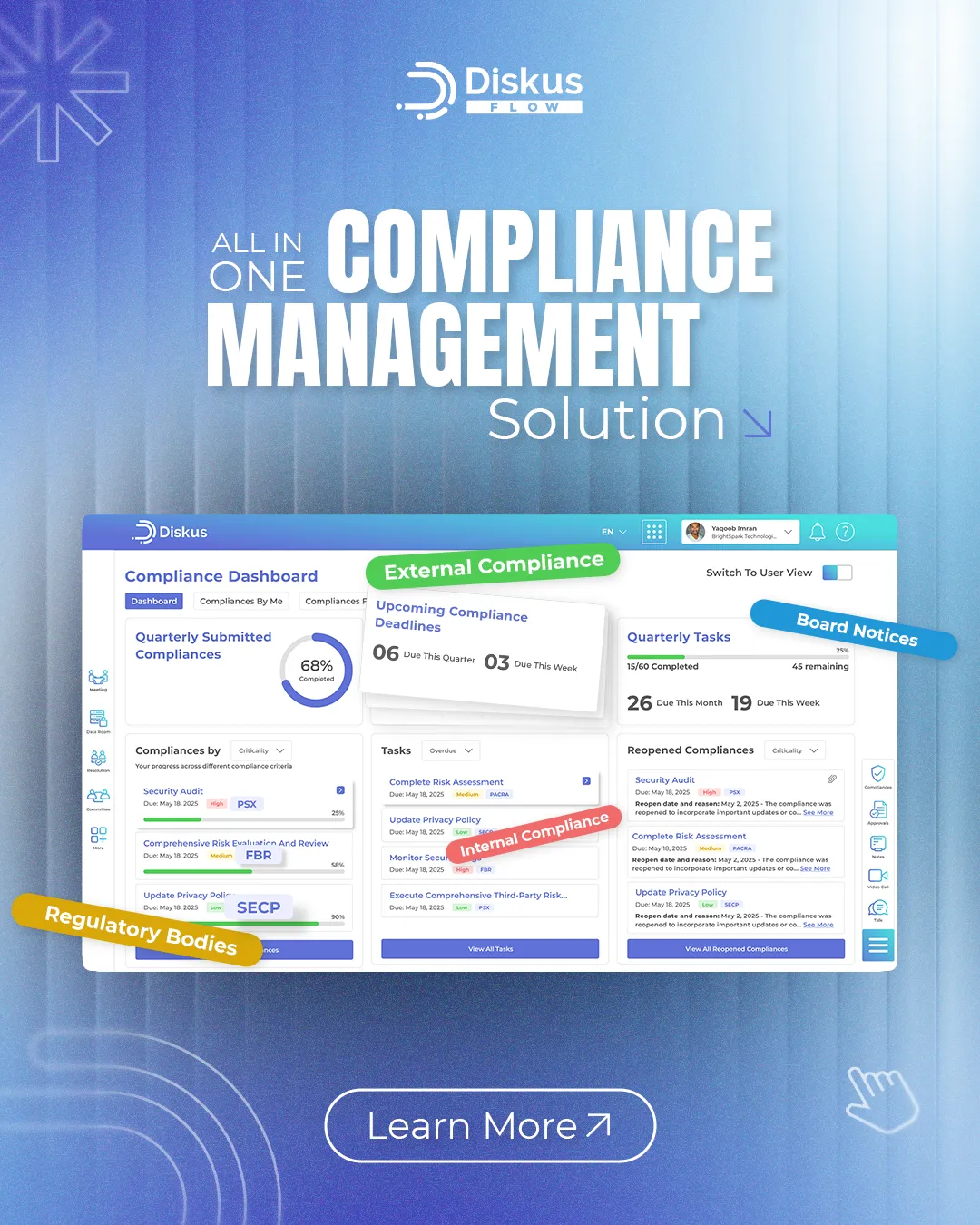
Diskus ensures secure and automated board compliance with regulations for elevated governance. Start your journey with Diskus and witness how we revolutionize your board meetings. Stay ahead with modern governance practices, Book a Demo today!
Scroll to Top