 English
  Arabic
Why Digital Boardrooms Are Still Struggling Despite Advanced Technology The concept of a digital boardroom has become a central part of modern governance strategies. Organizations are investing in board management software, board portals, and digital governance tools to improve efficiency, security, and decision-making. On paper, these systems promise seamless collaboration, real-time access to information, and faster board decisions. However, despite these technological advancements, many organizations are still struggling to realize the full benefits of a digital boardroom. The issue is not the availability of technology. Instead, it lies in how organizations implement and use these tools. One of the primary...

Why Digital Boardrooms Are Still Struggling Despite Advanced Technology
The concept of a digital boardroom has become a central part of modern governance strategies. Organizations are investing in board management software, board portals, and digital governance tools to improve efficiency, security, and decision-making. On paper, these systems promise seamless collaboration, real-time access to information, and faster board decisions.
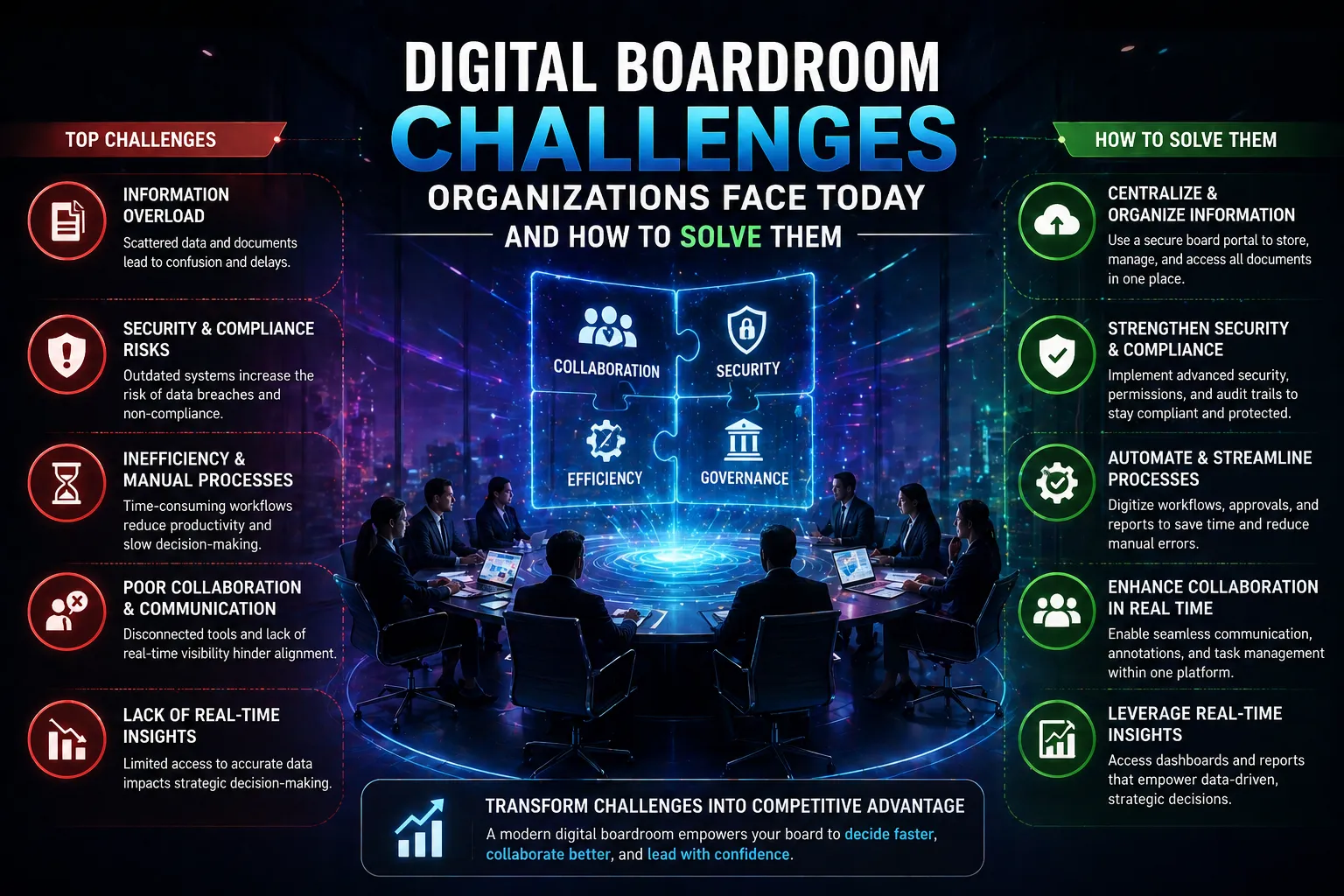
However, despite these technological advancements, many organizations are still struggling to realize the full benefits of a digital boardroom. The issue is not the availability of technology. Instead, it lies in how organizations implement and use these tools.
One of the primary challenges is the mismatch between technology and governance processes. Many organizations adopt digital tools without redesigning their workflows. As a result, the technology does not integrate naturally into board operations.
This creates a situation where digital systems exist alongside traditional processes rather than replacing them. Board members continue to rely on emails, PDFs, and manual workflows, which reduces the effectiveness of the digital boardroom.
Management thinker Clayton Christensen once said:
“Technology alone does not create value. It is how you use it that matters.”
This principle explains why many digital boardrooms fail to deliver expected outcomes.
The Integration Problem That Creates Fragmented Governance Systems
One of the most critical challenges in digital boardrooms is lack of integration. Organizations often use multiple tools for different aspects of governance, including document management, compliance tracking, communication, and reporting.
When these systems are not integrated, information becomes fragmented. Board members must switch between platforms to access documents, review updates, and participate in discussions. This not only slows down workflows but also increases the risk of errors.
For example, a board member may review a document in one system but discuss it via email or another platform. This creates inconsistencies, as updates are not synchronized across systems. Over time, it becomes difficult to determine which version of information is accurate.
The lack of integration also affects compliance. Regulatory requirements often demand clear documentation and audit trails. Fragmented systems make it difficult to maintain these records, increasing risk.
Why User Adoption Remains the Biggest Barrier to Digital Success
Even the most advanced board portal fails if board members do not use it consistently. User adoption is the single most important factor in the success of a digital boardroom.
Board members are typically senior professionals with established habits. They are used to working with familiar tools such as email and printed documents. Introducing new systems requires them to change these habits, which can be challenging.
Another factor is usability. If the platform is not intuitive, board members may find it difficult to navigate. This leads to frustration and reduced usage.
Time constraints also play a role. Board members have limited time to learn new systems. If the platform does not deliver immediate value, they are likely to revert to traditional methods.
Low adoption creates a hybrid environment where digital and manual processes coexist. This reduces efficiency and undermines the purpose of digital transformation.
Technology adoption expert Geoffrey Moore explained:
“Without user adoption, innovation is just invention.”
This highlights why adoption must be a priority.
Security and Compliance Pressures in Digital Boardrooms
Security is a major concern in digital boardrooms. Boards handle highly sensitive information, including financial data, strategic plans, and legal documents. Any breach can have serious consequences.
Digital systems must provide robust security features such as encryption, access control, and audit trails. However, implementing these features often adds complexity, which can affect usability.
Compliance requirements further increase the challenge. Organizations must ensure that their systems meet regulatory standards while remaining user-friendly. Balancing security and usability is one of the biggest challenges in digital governance.
Cybersecurity expert Bruce Schneier once noted:
“Security is a trade-off between protection and usability.”
In digital boardrooms, achieving this balance is critical.
How Poor Workflow Design Undermines Digital Boardroom Efficiency
Workflow design is often overlooked during digital transformation. Organizations implement board management software without redesigning their processes.
This leads to inefficiencies, as digital tools are forced to fit into outdated workflows. For example, if board packs are still prepared manually and then uploaded to a portal, the process remains inefficient.
Effective digital boardrooms require workflows that are designed for digital environments. This includes automated document management, real-time collaboration, and centralized communication.
Without proper workflow design, digital tools cannot deliver their full potential.
Strategies to Overcome Digital Boardroom Challenges
Organizations can overcome digital boardroom challenges by adopting a structured approach. The first step is to centralize governance systems. Using a unified platform for communication, document management, and decision tracking eliminates fragmentation.
The second step is to prioritize user experience. Platforms must be intuitive and easy to use. Training should focus on practical use cases, helping board members understand how the system improves their workflow.
Integration is another key factor. Systems should be connected to ensure seamless data flow across platforms.
Security and compliance should be built into the system rather than added as an afterthought. This ensures that governance requirements are met without compromising usability.
Finally, organizations must continuously monitor adoption and gather feedback. This allows them to identify issues and improve processes over time.
How Leading Organizations Build High-Performance Digital Boardrooms
Organizations that successfully implement digital boardrooms take a holistic approach. They focus not only on technology but also on processes and people.
They redesign workflows to align with digital tools. They invest in training and support to ensure adoption. They prioritize integration and security to create a seamless governance environment.
These organizations treat digital transformation as an ongoing process rather than a one-time project. This allows them to adapt to changing requirements and continuously improve performance.
Frequently Asked Questions
What are the biggest digital boardroom challenges
Integration issues, low user adoption, and security concerns.
Why do digital boardrooms fail
Because technology is implemented without aligning processes and user behavior.
How can organizations improve digital boardrooms
By centralizing systems, improving adoption, and redesigning workflows.
Final Insight
Digital boardrooms represent the future of governance, but success requires more than technology. Organizations must align tools, processes, and people to achieve true transformation.
Share this article on