
 English
  Arabic
Older Post
How to Align Teams Better with a Collaborativ…

Board meetings often end with agreement in the room. Everyone nods, the discussion feels settled, and the meeting moves on. Yet weeks later, the same topic returns. Actions were unclear. Responsibilities were assumed, not assigned. Momentum quietly faded. This gap between decision and execution is one of the most common board challenges. It is rarely caused by lack of intent. More often, it comes from weak structure after the meeting ends. This is where board meeting software plays a critical role in turning decisions into outcomes. Why Board Decisions Break Down After the Meeting and How Software Fixes the Gap...

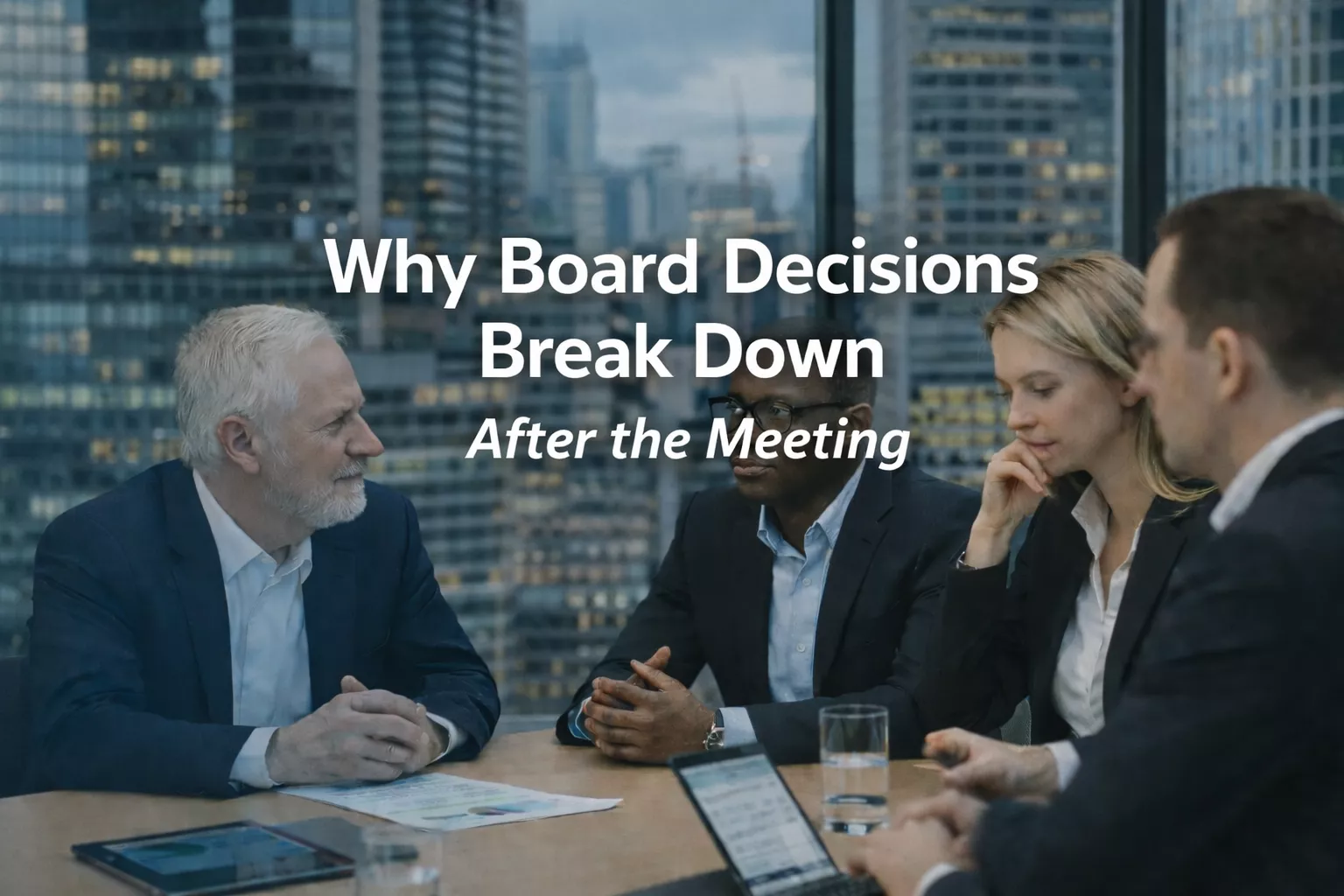
Board meetings often end with agreement in the room. Everyone nods, the discussion feels settled, and the meeting moves on. Yet weeks later, the same topic returns. Actions were unclear. Responsibilities were assumed, not assigned. Momentum quietly faded.
This gap between decision and execution is one of the most common board challenges. It is rarely caused by lack of intent. More often, it comes from weak structure after the meeting ends. This is where board meeting software plays a critical role in turning decisions into outcomes.
Inside the boardroom, decisions often feel obvious. Context is fresh. The discussion is active. Directors assume everyone understands what comes next. The problem begins when that shared context disappears.
Once the meeting ends, directors return to daily responsibilities. Executives move into operational mode. Without clear documentation, memories fade and interpretations diverge. What felt like agreement becomes ambiguity.
This is not a people issue. It is a process issue. Strong board meeting management ensures clarity survives beyond the meeting itself.
Execution usually breaks down in small, quiet ways:
When this happens, boards unintentionally create rework. Time is spent revisiting discussions instead of progressing strategy. Confidence in governance slowly erodes.
A Board Meeting Solution addresses this by treating follow-through as part of the meeting workflow, not an afterthought.
board meeting management software creates continuity. It connects decisions, actions, and accountability in one system. Instead of relying on memory, boards rely on structure.
A Board Meeting Management Solution supports follow-through in three key ways.
First, it captures decisions clearly. Outcomes are recorded alongside the agenda item, not buried in long minutes.
Second, it assigns ownership. Each action has a responsible person and a timeline. There is no confusion about who moves next.
Third, it keeps progress visible. A Board Management Portal allows directors to review action status before the next meeting. This creates natural accountability without pressure.
This shift changes board behavior. Conversations become more focused, knowing actions will be tracked.
Boards can strengthen follow-through with a few revealed habits:
When supported by Board Management Software, these habits become consistent instead of manual.
Good boards do not struggle with ideas. They struggle with execution discipline. When follow-through is weak, even the best decisions lose impact.
Diskus supports board meeting management by closing the gap between discussion and action. If your board wants decisions that actually move the organization forward, Diskus provides the structure to make that happen.


