 English
  Arabic
Why Accountability Is the Core of Effective Board Governance Accountability is the mechanism that ensures decisions lead to outcomes and responsibilities are clearly owned. In board governance, accountability connects strategy, oversight, and execution. Without it, even well-designed governance structures fail to deliver results. A board may have strong processes, experienced members, and access to data, but if accountability is weak, decisions are not followed through effectively. This creates gaps between what is planned and what is achieved. Accountability also plays a critical role in maintaining trust. Stakeholders expect boards to act responsibly and to ensure that leadership is held accountable...

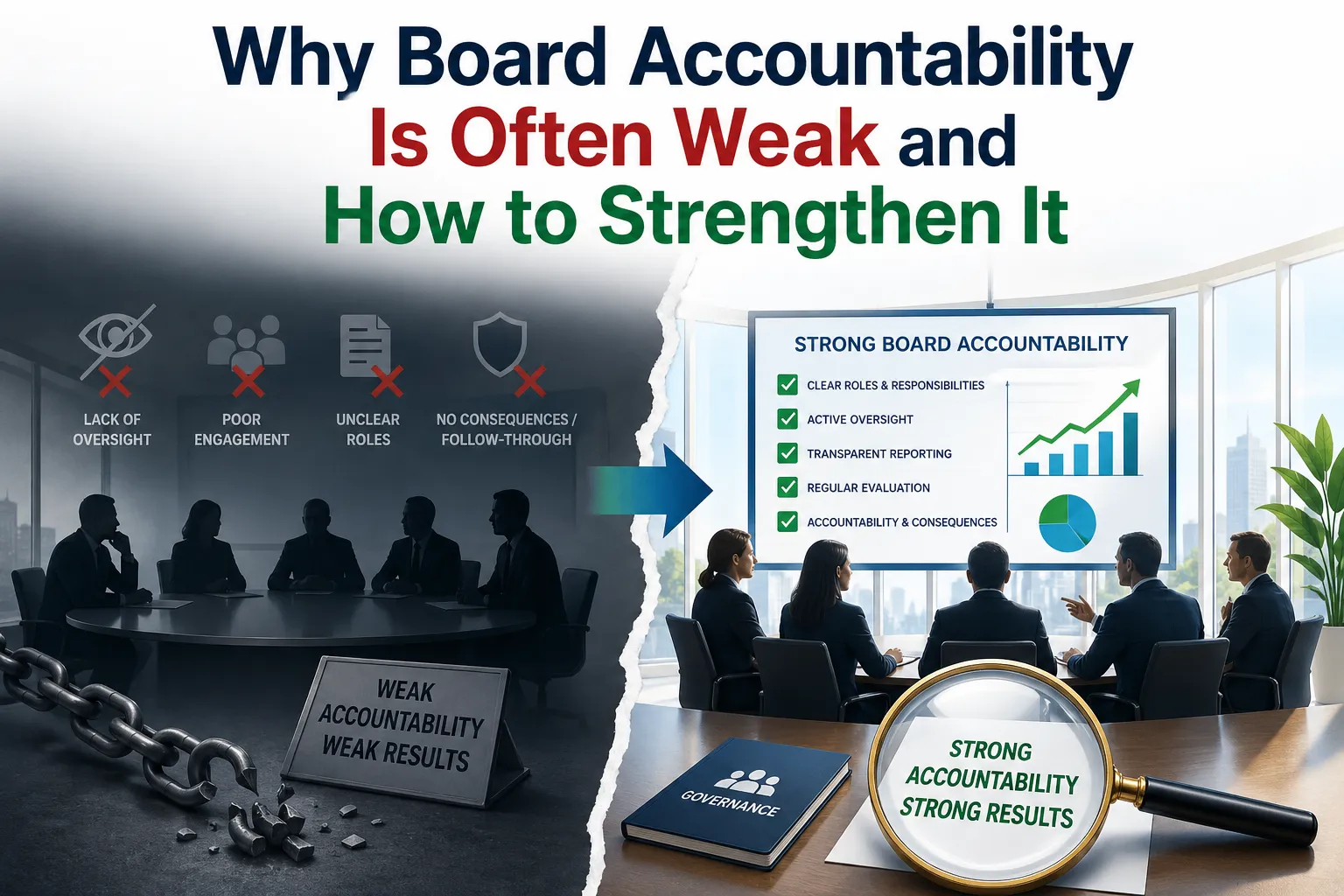
Why Accountability Is the Core of Effective Board Governance
Accountability is the mechanism that ensures decisions lead to outcomes and responsibilities are clearly owned. In board governance, accountability connects strategy, oversight, and execution. Without it, even well-designed governance structures fail to deliver results.
A board may have strong processes, experienced members, and access to data, but if accountability is weak, decisions are not followed through effectively. This creates gaps between what is planned and what is achieved.
Accountability also plays a critical role in maintaining trust. Stakeholders expect boards to act responsibly and to ensure that leadership is held accountable for performance.
Leadership expert John C. Maxwell once said:
“A leader is one who knows the way, goes the way, and shows the way.”
In governance, accountability ensures that leaders not only define direction but also take responsibility for outcomes.
The Structural Causes Behind Weak Board Accountability
Weak accountability often begins with structural issues. One of the most common problems is unclear roles and responsibilities. When responsibilities are not clearly defined, it becomes difficult to determine who is accountable for specific decisions or outcomes.
Another structural issue is lack of performance metrics. Without measurable indicators, it is challenging to evaluate whether decisions are effective. This creates ambiguity and reduces accountability.
In some organizations, there is also a lack of formal processes for tracking decisions. Without clear documentation, it is difficult to monitor progress and ensure follow-through.
Additionally, overlapping responsibilities between the board and management can create confusion. This blurs accountability lines and reduces effectiveness.
How Cultural Factors Weaken Accountability in Boardrooms
Beyond structure, culture plays a significant role in accountability. In some boardrooms, there is a tendency to avoid confrontation. Board members may hesitate to challenge decisions or question performance, especially when dealing with senior leadership.
This reluctance can lead to a lack of accountability, as issues are not addressed directly. Over time, this creates an environment where poor performance is tolerated.
Another cultural factor is groupthink. When board members prioritize consensus over critical evaluation, accountability is weakened. Decisions may not be thoroughly examined, and responsibility becomes diluted.
Building a culture that supports accountability requires openness, transparency, and willingness to engage in constructive debate.
The Impact of Weak Accountability on Governance Performance
Weak accountability has a direct impact on governance outcomes. Decisions may be made, but without clear ownership, implementation becomes inconsistent.
This leads to delays, missed targets, and reduced organizational performance. In some cases, initiatives may fail entirely due to lack of follow-through.
Weak accountability also affects risk management. When responsibilities are unclear, risks may not be properly addressed, increasing exposure.
Over time, these issues reduce the effectiveness of governance and limit the board’s ability to achieve its objectives.
Why Decision Tracking Is Essential for Accountability
Decision tracking is a critical component of accountability. Without a system to record and monitor decisions, it is difficult to ensure that actions are taken.
Tracking provides visibility into what decisions were made, who is responsible, and what progress has been achieved. This allows boards to evaluate performance and address issues proactively.
Many organizations struggle with decision tracking due to reliance on manual processes. This creates gaps and inconsistencies.
Modern governance requires structured systems that support accurate and consistent tracking.
How Digital Tools Strengthen Board Accountability
Modern board management software and board portals play a key role in improving accountability. These tools provide centralized platforms for documenting decisions, assigning responsibilities, and tracking progress.
Centralization ensures that all board members have access to the same information, reducing confusion. Automated tracking features provide real-time updates, improving visibility.
Audit trails enhance accountability by providing a record of decisions and actions. This supports transparency and ensures that responsibilities are clearly defined.
Organizations that adopt digital governance tools often experience stronger accountability and improved performance.
Practical Strategies to Improve Board Accountability
Strengthening accountability requires a structured approach. The first step is to clearly define roles and responsibilities. Each board member should understand their specific duties.
Establishing performance metrics is essential. Clear indicators allow boards to evaluate outcomes and measure success.
Implementing decision tracking systems ensures that actions are monitored and followed through.
Encouraging a culture of accountability is also important. Board members should feel comfortable addressing issues and holding each other accountable.
Regular reviews of governance processes help identify gaps and improve effectiveness.
How High-Performing Boards Maintain Strong Accountability
High-performing boards treat accountability as a central governance principle. They establish clear structures, define responsibilities, and implement systems that support tracking and evaluation.
These boards foster a culture of openness and constructive challenge. They prioritize transparency and ensure that all members are aligned.
Continuous evaluation allows them to maintain high standards and adapt to changing requirements.
Frequently Asked Questions
Why is board accountability often weak
Due to unclear roles, lack of metrics, and cultural barriers.
How does weak accountability affect governance
It leads to poor implementation, delays, and reduced performance.
How can accountability be improved
By defining roles, tracking decisions, and fostering accountability culture.
Final Insight
Board accountability is essential for effective governance. Organizations that strengthen accountability can improve decision-making, enhance performance, and build trust.
Share this article on