 English
  Arabic
Why Board Process Modernization Fails Even When Technology Is Available Modernizing board processes is no longer optional. Organizations are under pressure to improve governance, increase transparency, and accelerate decision-making. Tools such as board management software, board portals, and digital governance systems are widely available and highly capable. Despite this, many organizations fail to modernize effectively. The failure is rarely due to lack of technology. Instead, it stems from the way modernization is approached. Most organizations focus on implementing tools rather than transforming processes. They introduce digital solutions without addressing how board activities such as meeting preparation, communication, and decision tracking...

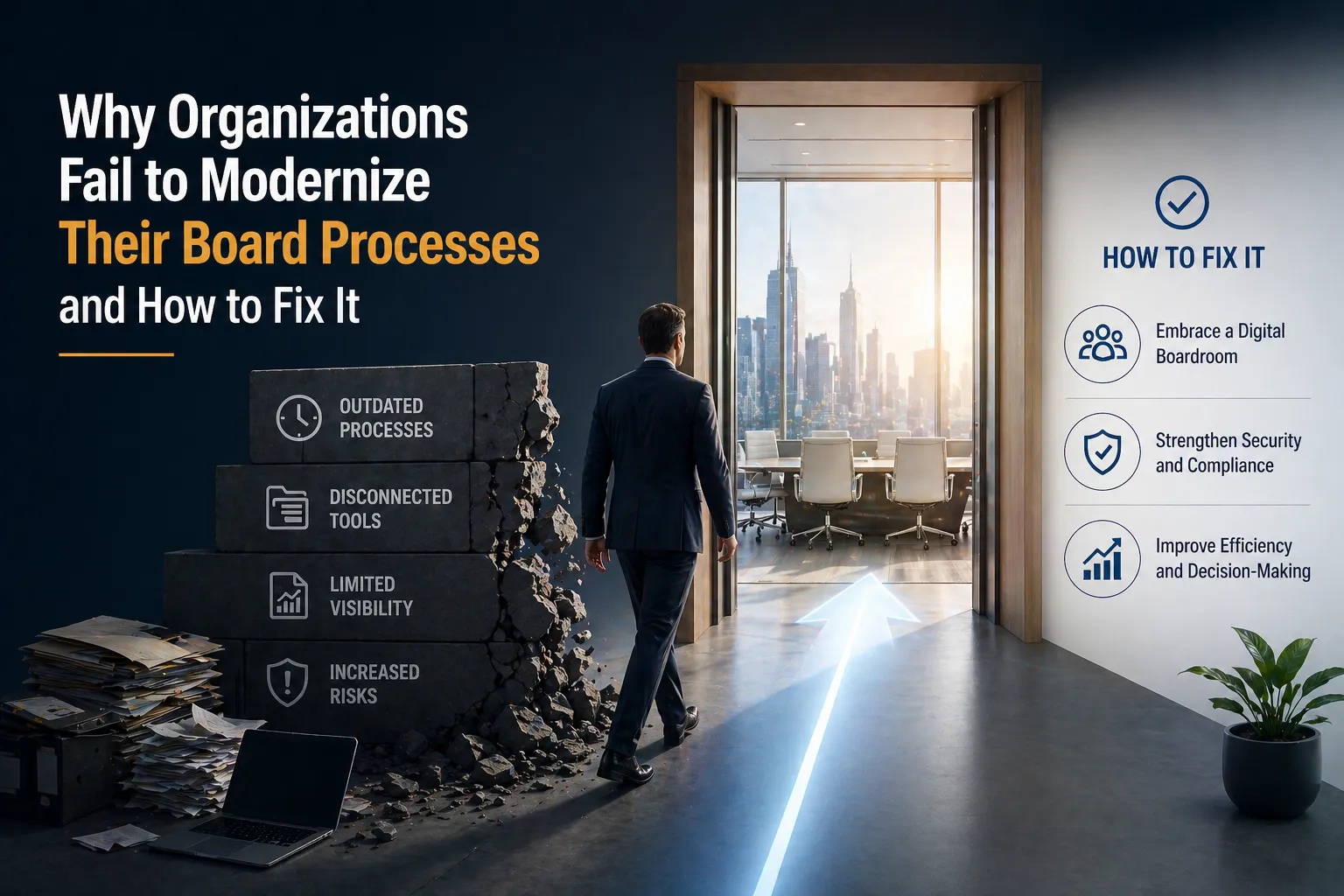
Why Board Process Modernization Fails Even When Technology Is Available
Modernizing board processes is no longer optional. Organizations are under pressure to improve governance, increase transparency, and accelerate decision-making. Tools such as board management software, board portals, and digital governance systems are widely available and highly capable.
Despite this, many organizations fail to modernize effectively. The failure is rarely due to lack of technology. Instead, it stems from the way modernization is approached.
Most organizations focus on implementing tools rather than transforming processes. They introduce digital solutions without addressing how board activities such as meeting preparation, communication, and decision tracking should evolve.
As a result, new tools are layered on top of old workflows. This creates complexity instead of efficiency. Board members continue to rely on emails, spreadsheets, and manual processes, while digital systems remain underutilized.
Business strategist Michael Porter once stated:
“The essence of strategy is choosing what not to do.”
Organizations that fail to modernize often try to do everything at once, without a clear strategic direction.
The Strategic Mistake of Treating Modernization as a Technology Project
One of the most common reasons organizations fail is that they treat board modernization as a technology initiative rather than a governance transformation.
Technology projects focus on implementation timelines, system features, and technical requirements. Governance transformation, on the other hand, focuses on improving how decisions are made, how information flows, and how boards operate.
When modernization is treated purely as a technology project, critical questions are ignored:
- How will board workflows change?
- How will decision-making improve?
- How will communication be centralized?
Without answering these questions, digital tools cannot deliver meaningful results.
How Organizational Culture Becomes the Biggest Barrier to Change
Culture plays a central role in modernization efforts. Board members often have established ways of working that have been successful in the past. This creates a natural resistance to change.
Unlike operational teams, boards operate at a strategic level. Stability and consistency are valued, which can make experimentation with new processes uncomfortable.
Another cultural factor is hierarchy. In some organizations, decision-making is concentrated among a few individuals. This limits open discussion about modernization and slows progress.
Resistance is often not explicit. It appears as low engagement with new tools, delayed adoption, or continued reliance on traditional methods.
Leadership expert John Kotter explained:
“Transformation is impossible unless hundreds or thousands of people are willing to help, often to the point of making short-term sacrifices.”
This highlights the importance of collective commitment in modernization.
The Hidden Role of Workflow Design in Modernization Failure
Workflow design is one of the most overlooked aspects of board modernization. Organizations often implement board portals without redesigning how work is done.
For example, if board packs are still compiled manually and then uploaded to a digital platform, the process remains inefficient. Similarly, if discussions continue through email instead of within the platform, communication remains fragmented.
Effective modernization requires workflows that are designed specifically for digital environments. This includes:
- Automated agenda creation
- Real-time document updates
- Centralized communication channels
- Integrated decision tracking
Without redesigning workflows, digital tools cannot deliver their full potential.
Why Lack of Clear Ownership Derails Modernization Efforts
Another major challenge is lack of ownership. Modernization initiatives often involve multiple stakeholders, including IT teams, governance teams, and board members.
Without a clear owner, responsibility becomes diluted. Decisions are delayed, and progress slows down.
Successful organizations assign a dedicated leader to oversee modernization. This individual ensures that the project stays on track, addresses challenges, and drives adoption.
Ownership also ensures accountability. When someone is responsible for outcomes, there is a greater focus on achieving results.
How Poor Measurement Prevents Continuous Improvement
Many organizations fail to measure the success of their modernization efforts. Without metrics, it is difficult to determine whether changes are effective.
Key metrics may include:
- Board meeting preparation time
- Decision-making speed
- User adoption rates
- Document access efficiency
Without tracking these metrics, organizations cannot identify areas for improvement. This leads to stagnation and prevents continuous progress.
Modern governance requires a data-driven approach. Boards must evaluate their processes regularly and make adjustments based on insights.
Proven Strategies to Successfully Modernize Board Processes
To successfully modernize board processes, organizations must adopt a structured approach. The first step is to define a clear strategy. This includes identifying objectives such as improving efficiency, enhancing security, or accelerating decision-making.
The second step is to redesign workflows. Processes should be aligned with digital tools to ensure seamless integration.
The third step is to invest in training. Board members must understand how to use the system and how it benefits them.
Integration is another critical factor. Systems should be connected to ensure smooth data flow across platforms.
Finally, organizations must establish continuous improvement mechanisms. Regular feedback and performance monitoring help refine processes over time.
How Leading Organizations Achieve Sustainable Board Transformation
Organizations that successfully modernize their board processes take a long-term view. They treat modernization as an ongoing journey rather than a one-time project.
They continuously evaluate their systems, update workflows, and invest in new technologies. They also prioritize user experience, ensuring that board members are comfortable with digital tools.
These organizations achieve higher efficiency, better decision-making, and stronger governance outcomes.
Frequently Asked Questions
Why do organizations fail to modernize board processes
Because they focus on tools instead of strategy and fail to redesign workflows.
What is the biggest barrier to modernization
Cultural resistance and lack of clear ownership.
How can modernization be successful
By aligning strategy, workflows, and technology.
Final Insight
Modernizing board processes is not about adopting new tools. It is about transforming how boards operate. Organizations that approach modernization strategically can achieve significant improvements in governance and performance.
Share this article on