 English
  Arabic
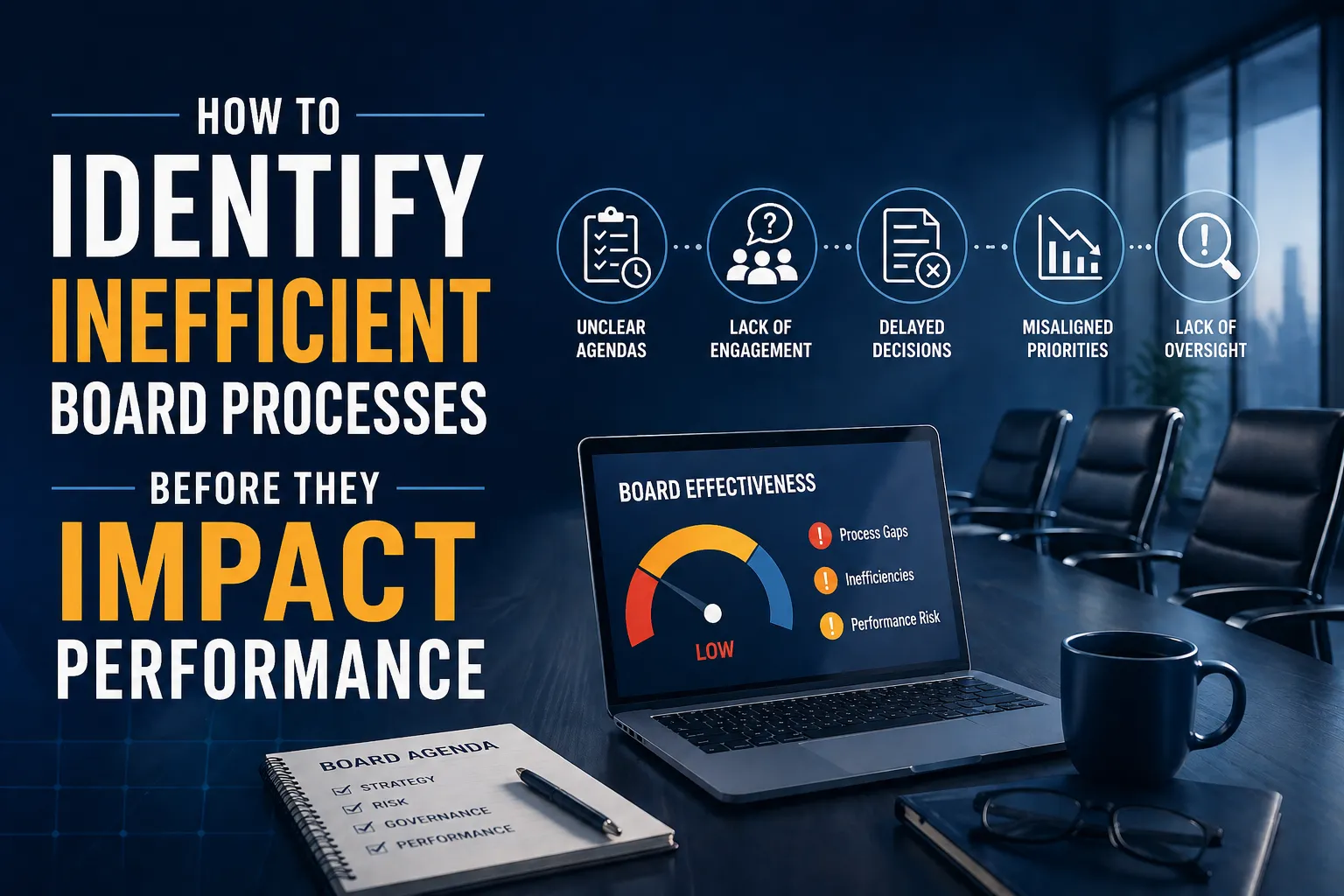
Why Inefficient Board Processes Often Go Unnoticed Inefficiency in board processes rarely appears as a single obvious problem. Instead, it develops gradually through small inefficiencies that become normalized over time. Because these issues are subtle, many organizations fail to recognize them until performance is already affected. Boards often assume that long meetings, delayed decisions, or administrative workload are simply part of governance. In reality, these are signs of deeper process inefficiencies. The challenge is that traditional governance methods do not provide clear visibility into performance. Without measurable indicators, it is difficult to identify where inefficiencies exist. Operational strategist Eliyahu Goldratt...

Why Inefficient Board Processes Often Go Unnoticed
Inefficiency in board processes rarely appears as a single obvious problem. Instead, it develops gradually through small inefficiencies that become normalized over time. Because these issues are subtle, many organizations fail to recognize them until performance is already affected.
Boards often assume that long meetings, delayed decisions, or administrative workload are simply part of governance. In reality, these are signs of deeper process inefficiencies.
The challenge is that traditional governance methods do not provide clear visibility into performance. Without measurable indicators, it is difficult to identify where inefficiencies exist.
Operational strategist Eliyahu Goldratt once said:
“Tell me how you measure me, and I will tell you how I will behave.”
In governance, what is not measured is rarely improved.
The Most Common Indicators of Inefficient Board Processes
One of the earliest signs of inefficiency is repetition in discussions. When the same topics are revisited multiple times without resolution, it indicates a lack of structured decision-making.
Another clear indicator is difficulty accessing information. If board members spend time searching for documents or verifying versions, it reflects poor information management.
Delayed decision-making is another major signal. When decisions take longer than expected, it often points to inefficiencies in preparation, communication, or data clarity.
Excessive administrative workload is also a strong indicator. When teams spend significant time on manual tasks such as compiling reports or distributing documents, it reduces overall productivity.
Organizations experiencing these issues are often operating below optimal efficiency without realizing it.
How Meeting Inefficiencies Reveal Deeper Process Problems
Board meetings provide valuable insights into process efficiency. If meetings consistently run over time, lack focus, or fail to produce clear outcomes, it is a strong indication of underlying issues.
Unstructured agendas are a common cause. Without clear priorities and objectives, discussions become unfocused and time-consuming.
Lack of preparation also contributes to inefficiency. When board members are not fully prepared, meetings shift from decision-making to information sharing.
Another issue is fragmented communication. When discussions occur across multiple channels, alignment becomes difficult.
These meeting-level inefficiencies often reflect broader governance challenges.
The Role of Data and Reporting in Process Efficiency
Data plays a critical role in identifying inefficiencies. Boards rely on reports to understand performance and make decisions. However, if reporting is unclear or inconsistent, it can obscure inefficiencies rather than reveal them.
Information overload is a common problem. When reports contain excessive data without clear insights, board members struggle to focus on key issues.
Timing is another factor. Late delivery of reports limits preparation and reduces meeting effectiveness.
Improving reporting processes is essential for identifying and addressing inefficiencies.
Why Lack of Visibility Makes Inefficiencies Worse
One of the biggest challenges in identifying inefficient processes is lack of visibility. Traditional governance methods do not provide real-time insights into how processes are functioning.
Without visibility, inefficiencies remain hidden. Boards may continue using ineffective processes simply because they are not aware of better alternatives.
This lack of awareness prevents improvement and allows inefficiencies to persist.
Organizations that prioritize visibility are better equipped to identify and address process issues.
How to Conduct a Practical Board Process Audit
A structured audit is one of the most effective ways to identify inefficiencies. This involves evaluating key areas such as meeting structure, communication, reporting, and decision-making.
The first step is to analyze meeting performance. This includes reviewing duration, outcomes, and participant engagement.
Next, assess information management. Determine how documents are stored, accessed, and updated.
Evaluate communication channels to identify fragmentation or delays.
Finally, review decision-making processes to ensure they are structured and efficient.
This audit provides a clear picture of where improvements are needed.
How Board Management Software Reveals and Fixes Inefficiencies
Modern board management software provides tools that make inefficiencies visible and easier to address. These platforms centralize all board activities, creating a single source of truth.
Centralization improves visibility by ensuring that all information is accessible and up to date. This reduces confusion and delays.
Automation eliminates manual tasks, improving efficiency and reducing administrative workload.
Analytics features provide insights into meeting performance, decision timelines, and process efficiency.
Organizations that adopt these tools often discover inefficiencies that were previously hidden.
Why Early Identification Leads to Competitive Advantage
Identifying inefficiencies early allows organizations to address them before they impact performance. This creates a significant competitive advantage.
Boards that operate efficiently can make decisions faster, respond to changes more effectively, and align strategy with execution.
In contrast, organizations that fail to address inefficiencies may struggle to keep up with competitors.
Efficiency at the board level translates into agility across the organization.
Frequently Asked Questions
How do you identify inefficient board processes
By analyzing meetings, communication, reporting, and decision-making.
What are the biggest signs of inefficiency
Repeated discussions, delayed decisions, and administrative overload.
How can inefficiencies be fixed
By improving processes and using board management software.
Final Insight
Inefficient board processes are often hidden but have a significant impact on performance. Organizations that proactively identify and address these issues can improve governance and achieve better outcomes.
Share this article on